True mate
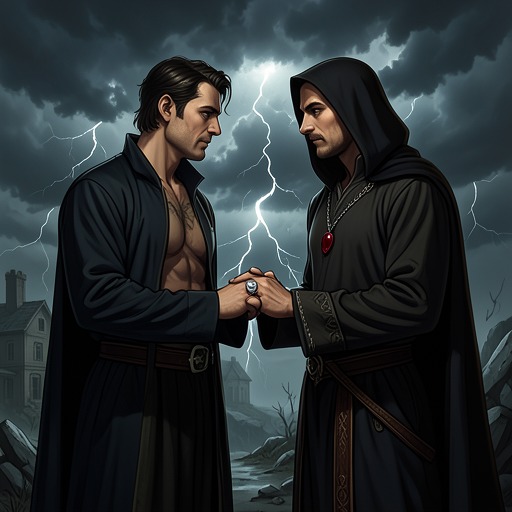
The Vampire Prince’s BrideTrue mate is the novel’s recurring concept of a destined life partner, a relationship that appears to precede ordinary courtship and often carries consequences for sex, reproduction, loyalty, political succession, and personal identity. The idea is presented as both an intimate recognition and a social force. Characters may discover that someone is their mate through instinct, a dating-site encounter, a mystical object, or the sudden certainty that an apparently accidental attraction has a deeper cause. Yet the bond does not erase negotiation: again and again, the story distinguishes being drawn to someone from deciding what obligations, protections, and forms of commitment should follow.
Definition and Recognition
True mate first appears as an answer to romantic uncertainty. Amelia has spent years choosing the wrong men and has reached thirty when she creates a profile on a shifter dating website whose promise is “Meet your one true mate.” The appeal is not merely physical attraction. She imagines a shifter as devoted to a mate, in contrast with the exhausting human process of sorting through hundreds of contacts in the hope of finding one compatible person. The website therefore translates a supernatural principle into a modern form: technology becomes a meeting place for a bond that the characters still understand as rare, selective, and almost fated.
Xavier and Timothy experience the reverse movement. After years of searching among the werewolves of their joint pack, the two Alphas had begun to fear that no female existed for them. Amelia’s photograph changes that fear immediately. Their recognition is not described as casual flirtation; seeing her picture gives shape to a search they had nearly abandoned. The bond consequently operates as retrospective meaning. It makes earlier loneliness look like preparation and turns a digital encounter into the discovery of a person the characters had been waiting for without fully knowing it.
The concept also has a collective dimension. Xavier and Timothy explain that they were expected to form a triad with a strong female so that both packs could survive. Their society could have forced a dominance struggle between them, leaving only one Alpha, but their lifelong closeness led them to desire a triad rather than compete for sole rule. Their relationship shows that a true mate is not necessarily a simple pair bond. It can be incorporated into an Alpha triad, linking personal desire to leadership, pack survival, and a structure in which three people must define their obligations together.
Choice, Consent, and Commitment
The novel repeatedly tests the difference between destiny and coercion. Xavier and Timothy reject the idea that their expected triad meant they were simply forced into a predetermined arrangement. They describe the social expectation, but also emphasize that they would have fought for dominance if they could not lead together and that, apart from a brief period during Timothy’s adolescence, they had wanted a triad. Their account makes choice part of the bond’s legitimacy. Destiny may establish the possibility or pressure of union, but the relationship becomes meaningful when the people involved affirm it rather than merely submit to it.
That principle reaches its clearest ceremonial expression when Xavier and Timothy propose marriage to Amelia. By werewolf standards, the three are already mated, yet the Alphas recognize that Amelia wants a human wedding tradition. They kneel together and offer two small velvet boxes containing a gold ring and a silver ring designed to interlock on her fingers. The proposal does not replace the supernatural bond; it translates it into a form Amelia can understand and publicly claim. Her delighted acceptance completes a movement from instinctive recognition to chosen marriage.
Other relationships expose the danger of treating a mate as property or reproductive equipment. Ryan identifies Danita as his and Killian’s mate even while Killian tries to explain their attraction as desire for a beautiful woman. Ryan understands that the connection is deeper than pleasure, but that recognition does not automatically solve the material threat surrounding her. Danita is controlled through debt, and Killian refuses to kill McGrath because doing so would require them to pay double her ransom to the Lion. Instead, he negotiates an agreement to buy Danita’s freedom, receiving a month to pay her debt plus an additional two hundred and fifty thousand dollars. The mate bond motivates protection, but the lovers still have to confront a system that prices a woman’s liberty.
Killian eventually states the relationship plainly: Danita is their mate. For Ryan, this admission offers hope that the three-quarter-of-a-million-dollar payment might persuade the Leopard to release her. The scene turns fate into responsibility. Calling Danita a mate intensifies the men’s obligation to defend her, but it also reveals the ugliness of a world in which devotion must be expressed through a ransom agreement before she can be left alone.
Signs, Objects, and Bodies
True mate recognition can be externalized through a supernatural sign. Darilth gives Ella a silver band set with a large blue stone. The band shrinks to fit her wrist, and the stone shines brightly when he identifies it as the Draco’s Eye. As heir to the Rothgar throne, Darilth is its bearer; when he first saw Ella on Earth, the stone showed him that she was his destined mate. The object therefore joins romance to dynastic succession. Ella is not only the woman Darilth loves or chooses; her status is confirmed by an artifact connected to the throne and to his inherited authority.
The Draco’s Eye also changes the emotional grammar of recognition. Darilth can explain why he chose Ella without reducing his answer to preference or convenience: the stone made the recognition legible at the moment of their first meeting. Yet the band becomes meaningful only when he removes it and places it on Ella. The sign is transferred from royal possession into shared intimacy. A dynastic emblem becomes a personal token, while the act of giving it suggests that true mate status is not complete until it is acknowledged between the two people.
The concept is also entangled with bodies that defy ordinary categories. Sara’s bionic eyes are revealed to be capable of functioning as concealed stun grenades, and she uses one during an escape to protect Tom. Her artificial eyes demonstrate that identity and capability cannot be separated into a pure human interior and a merely mechanical exterior. Lisa’s pregnancy is likewise confirmed through technological imaging: a medical device presses nodules against her abdomen and constructs a three-dimensional hologram of her uterus and embryo. The embryo initially looks like a mixture of a tadpole and a dinosaur rather than a recognizable human baby, but the scan confirms a developing child. In these scenes, intimate truths are read through bodies altered by technology or crossing species boundaries, making partnership inseparable from questions of reproduction, embodiment, and the limits of the human.
Shay gives Gemma a biological explanation for another version of this boundary crossing. Stlozyn ancestors were humans taken from Earth centuries earlier; their descendants were not simply modified, but had certain genes made more pronounced and additional DNA strands added, allowing them to shift shapes. Shay and Gemma’s child is growing normally, leading Shay to conclude that humans and Stlozyn are technically the same species, though different subspecies. The explanation places true-mate and reproductive relationships within a larger world where ancestry, species, and bodily form are mutable rather than fixed.
Social and Reproductive Consequences
True mate relationships frequently carry expectations about children. Sheridan tells Maribel that he has carried her scent in his mind since she entered his palace and that he knew she was the woman he had been looking for. When Maribel asks what he was looking for, his answer is direct: he wants her to bear him a child. The declaration exposes the reproductive pressure hidden inside the language of destiny. Sheridan’s recognition may be genuine, but he initially articulates the bond through the function he expects Maribel to perform.
The same tension appears in Cheryl’s royal transition. Priest Quincy leads her from the temple on a hovering platform while crowds chant her name, delivering her to the palace where she expects to meet one king. Instead, two men wait below. The public ceremony turns an intimate and political arrangement into spectacle, and Cheryl’s future is framed by the expectation that she will provide royal children. Her body is treated as part of succession, while the appearance of two potential kings disrupts the tradition that should have made her role legible.
Cheryl ultimately asserts that the bond among herself, Bjorn, and Maskin must be governed by her own terms. After the two men have been injured and return with her to her cabin, she declares that if one of them has her, the other must also be included, always. Neither man may be alone with her, and if they fight again, she will have neither of them. Her choice transforms a rivalry into a conditional triad. The ultimatum does not deny desire or royal obligation; it prevents those forces from turning her into the prize of a contest. True mate logic here becomes a framework for mutual accountability only because Cheryl establishes the conditions of participation.
Maskin’s handmade grass necklace reinforces the contrast between institutional possession and personal recognition. As a warrior-slave, he has known women mainly through artificial companions awarded briefly for battlefield excellence. A flesh-and-blood woman therefore represents a startling break from the controlled encounters available to him. Making a necklace for Cheryl is not a royal command, a reproductive demand, or a transaction. It is a small gift offered to create affection, and her acceptance produces an emotional response he does not know how to interpret. The gesture gives the bond a material form without claiming ownership over her.
Narrative Significance
Across the book, true mate functions as a language for the pressure between fate and freedom. It can explain why characters are drawn together before they understand one another, as with Amelia’s meeting with Xavier and Timothy, Ryan’s certainty about Danita, and Darilth’s recognition of Ella through the Draco’s Eye. It can also be used to justify dynastic reproduction, political arrangements, or claims over another person’s body, as Sheridan’s demand of Maribel and the expectations surrounding Cheryl demonstrate.
The most significant pattern is therefore not that destiny always guarantees happiness. It is that the narrative keeps asking what characters do after destiny has named the relationship. Amelia receives the human ceremony she wants. Danita’s mates convert recognition into a costly rescue plan. Cheryl converts a royal triangle into an explicitly chosen and enforceable arrangement. Darilth shares the royal sign that confirmed Ella’s place in his future. In each case, the bond becomes ethically meaningful through an action—proposal, payment, gift, ultimatum, or public acknowledgment—that turns invisible certainty into a negotiated social reality.
True mate thus links the novel’s romantic plots to its broader concerns with species difference, technology, inheritance, slavery, and reproductive power. The concept crosses human and shifter communities, royal and ordinary lives, ancient signs and modern dating platforms, natural bodies and engineered ones. Its recurring question is whether a destined connection narrows a person’s choices or gives those choices a language strong enough to resist abandonment, coercion, and loneliness. The answer remains conditional: the bond may begin in fate, but its legitimacy is repeatedly established—or challenged—by consent, reciprocity, and the forms of life the partners choose to build.